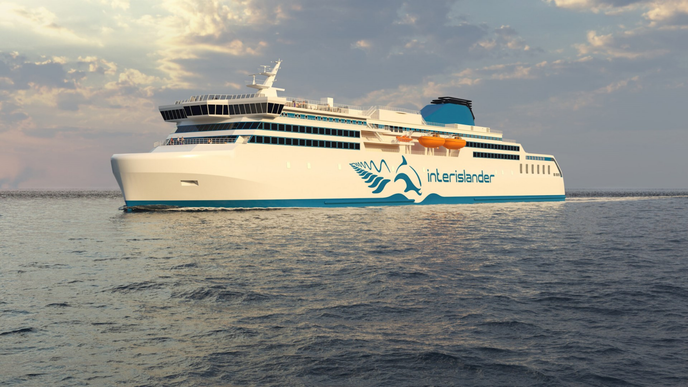
New details have been released about the safety, capacity and environmental features of the two Cook Strait ferries due to enter service in 2029.
Ferry Holdings is working with KiwiRail and Guangzhou Shipyard International on the detailed design of the vessels, which are being built specifically for the Wellington-Picton route.
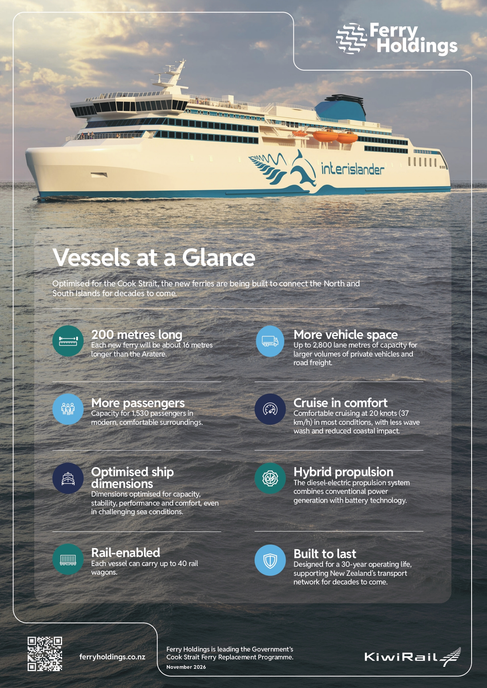
Each ferry will be 200 metres long — about 16 metres longer than the former Aratere — and provide up to 2800 lane metres for vehicles and freight.
The vessels will carry up to 1530 passengers and 40 rail wagons, with a cruising speed of 20 knots, or 37km/h. They are being designed for a 30-year operating life.
Ferry Holdings chair Chris Mackenzie says the ships will go beyond standard new-build requirements to improve reliability and minimise their environmental impact.
“The new Cook Strait ferries are being designed specifically for their route between Wellington and Picton, going above and beyond a typical new build to ensure resilience, reliability and minimise any impacts on the environment,” Mackenzie says.
The vessels will use hybrid diesel-electric propulsion combining conventional generation with battery technology. They will also feature onboard solar panels, battery storage and shore-power capability.
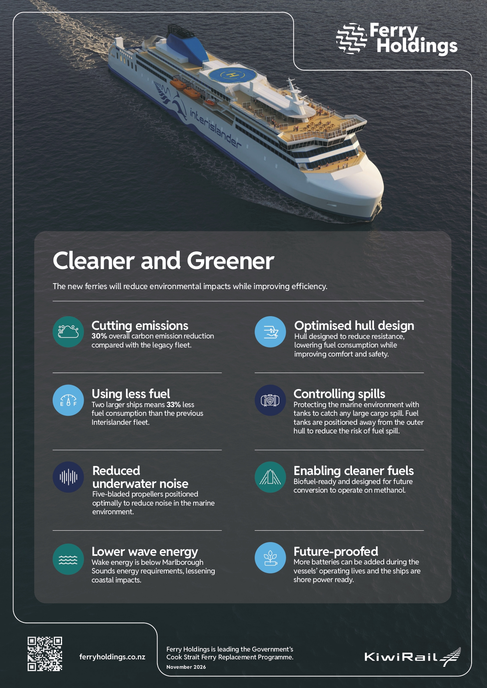
Ferry Holdings says their size, fuel-efficient engines, battery power and optimised hull design will reduce carbon emissions by 30% for every passenger and unit of cargo carried compared with the existing fleet.
Fuel consumption is expected to be about 33% lower than the previous Interislander fleet, while five-bladed propellers and low-vibration propulsion are designed to reduce underwater noise.
The ships will be biofuel-ready and designed for possible future conversion to methanol. Additional batteries could also be installed during their operating lives.
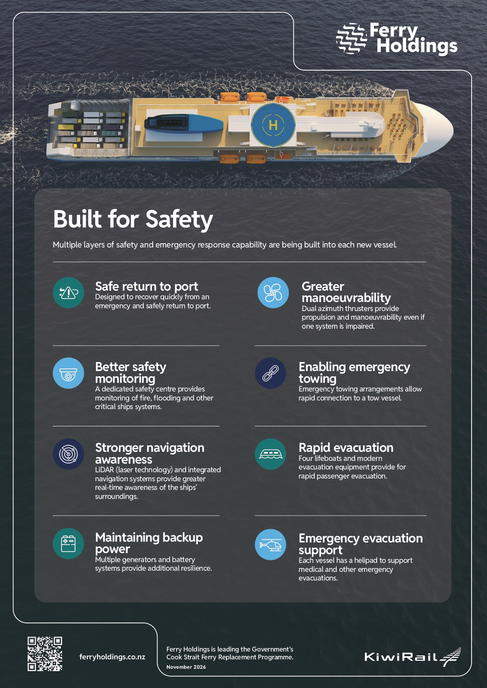
Safety features will include LIDAR scanning and integrated navigation systems to improve crews’ awareness of surrounding conditions.
Propulsion, steering and power systems will include additional redundancy, allowing the vessels to recover quickly from failures and maintain manoeuvrability.
Remote anchor deployment, emergency towing arrangements, spill-containment tanks and rapid evacuation equipment will also be incorporated. Each ship will have a helipad to support medical and other emergency evacuations.
Mackenzie says the additional safeguards are important because much of the route passes through the confined waters of Wellington Harbour and the Marlborough Sounds.
Interislander general manager operations Taru Sawhney says its employees have contributed to the interior layouts, crew accommodation, customer areas and technical design.
“We are excited about the arrival of the new vessels and are in full planning mode as we prepare for the transition from old to new,” Sawhney says.
Associated port infrastructure work in Wellington and Picton remains scheduled for completion before the ferries arrive in 2029.
Construction of Wellington’s new wharf extension began in July, while work on Picton’s new wharf is expected to begin in February 2027.