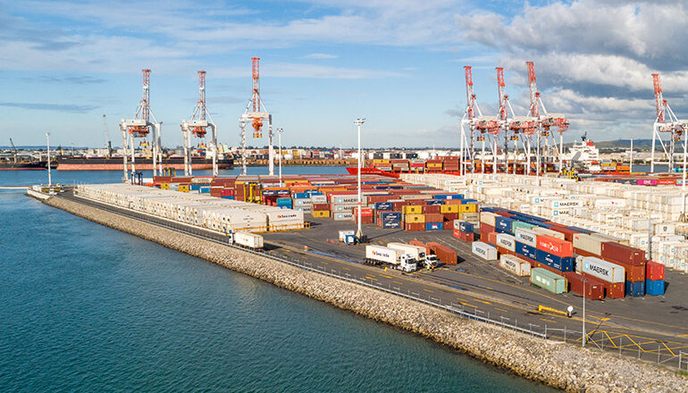
Port of Tauranga is progressing plans for a $100 million first stage of container terminal automation as it advances major infrastructure projects aimed at increasing capacity and accommodating larger vessels.
In a governance presentation released on October 12, the port outlined progress on its automated stacking crane project, the Stella Passage development, Northport expansion and Ruakura Inland Port operations.
The update comes as the port faces appeals against resource consent granted for its Stella Passage development, which would provide new berths on both sides of Tauranga Harbour.
Consent for the project was approved on September 7, following a fast-track process that began in January.
However, tangata whenua parties lodged appeals against the decision in October, creating further uncertainty around the development.
The port says the project forms a central part of its strategy to build infrastructure capable of accommodating larger ships and increasing cargo volumes.
Its wider hub port strategy is focused on capturing additional transhipment cargo, expanding rail and inland port connections, and reducing supply chain costs for importers and exporters.
Terminal automation progresses
Port of Tauranga is also advancing plans to introduce fully electric automated stacking cranes (ASCs) at its container terminal.
The company says a final-form contract is nearing completion, while software has already been implemented to test the technology virtually.
A proof-of-concept milestone for hybrid terminal operations has been achieved through emulation testing.
The proposed system would be introduced progressively over four phases, comprising nine automated stacking crane blocks.
Stage one, involving two blocks, is expected to cost around $100 million.
The port says fully electric automated stacking cranes could deliver approximately 75% fewer emissions compared with traditional straddle carrier operations.
Deployment will be linked to the timing of berth extensions, with further stages introduced as container volumes increase.
The investment is intended to improve terminal capacity, productivity and safety while reducing emissions.
Northport expansion linked to rail development
The presentation also highlights progress at Northport, where expansion plans remain closely tied to the proposed Marsden Point rail spur.
Northport Group was established in July 2025, with resource consent for its Vision for Growth development granted in October that year.
KiwiRail is undertaking detailed engineering and cost evaluations for the Marsden rail connection.
Three contractor groups — Acciona, Downer/HEB and Martinus Rail — have been selected to compete on lower-cost design options ahead of a government funding decision.
The proposed third berth and container terminal extension at Northport will be linked to the timing of the rail spur.
Rhys Jones took over as Northport Group chief executive on July 1.
The port says the development forms part of its response to forecast population growth, shifting manufacturing and distribution activity, and capacity constraints across the North Island.
Ruakura records container growth
Meanwhile, Ruakura Inland Port in Hamilton handled 24,067 twenty-foot equivalent units (TEU) during the 2026 financial year, up 6.8% from 22,525 TEU the previous year.
The inland port forms part of Port of Tauranga’s strategy to expand its freight network and support the movement of cargo between major distribution centres and seaports.
The presentation says a joint venture between Tainui Group Holdings and Brookfield will support further development and container growth at Ruakura.
The port is also looking to expand its wider network through investment in Northport and the planned launch of its TerminalConnect empty container facility.
Board succession and governance
Alongside the infrastructure updates, Port of Tauranga outlined its board succession plans and future director requirements.
Chair Julia Hoare and independent director Alison Andrew presented the governance update, which identifies operational transformation, infrastructure development, technology and resource management as priority areas for future board appointments.
The port is considering potential director appointments from April and October 2027 as part of succession planning through to 2029.
The presentation also confirms Ken Shirley, appointed to the board in April 2026, will stand for election at the company’s annual meeting.
Director Fraser Whineray will seek re-election following his retirement from the Quayside Holdings board on September 30.
The board has determined that neither Shirley nor Whineray is independent and has unanimously recommended shareholders support both appointments.
The port says its long-term strategy remains focused on developing hub-scale infrastructure, growing cargo volumes and improving supply chain efficiency as international shipping continues shifting towards larger vessels and hub-and-spoke networks.