

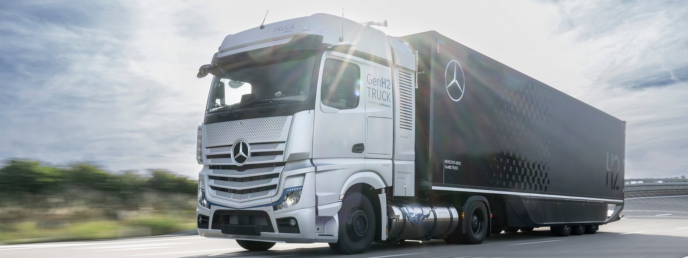
Daimler Truck is set to deploy five Mercedes-Benz GenH2 hydrogen fuel cell trucks as part of first customer trials from mid-2024.
Amazon, Air Products, INEOS, Holcim and Wiedmann & Winz will take part using semi-trail tractors in different long-haul applications on specific routes in Germany, such as the transport of building materials, sea containers and cylinder gases.
The vehicles will be refuelled at designated public liquid hydrogen filling stations in the town of Wörth am Rhein and in the Duisburg area.
It marks the next development phase of the hydrogen-powered trucks which have been completing testing on track and public roads.
Daimler says the first customer trials represent an “advanced development stage” of the fuel cell trucks.
Logistics provider Wiedmann & Winz will be one of the first companies to trial the Mercedes-Benz GenH2 Truck, using it to transport sea containers to and from industrial and commercial customers.
Managing director Dr. Micha Lege sees a high deployment potential for the truck, particularly on pan-European logistic routes.
“Our company has always been a frontrunner when it comes to innovation. Through FleetBoard, for example, Wiedmann & Winz was one of the first companies to rely on telematics and digitalisation in the logistics industry.
“We have also recently started deploying an eActros 300 as a tractor in everyday haulage operations. Now we are looking forward to taking the next step with the GenH2 Truck, testing a long-haul truck with hydrogen fuel-cell drive.”
New liquid hydrogen technology
Daimler Truck says it prefers liquid hydrogen in the development of hydrogen-based drives. In this aggregate state the energy carrier has a significantly higher energy density and transport costs can also be significantly reduced, the company says.
“As a result, more hydrogen can be carried, which significantly increases the range and enables comparable performance of the vehicle with that of a conventional diesel truck. Liquid hydrogen tanks also offer advantages in terms of cost and weight. Therefore, the use of liquid hydrogen enables a higher payload,” it says.
For the first time, a new refuelling process for liquid hydrogen will be used in the customer-trial fleet: the so-called “sLH2 technology” (sLH2 = “subcooled” liquid hydrogen).
The technology was developed jointly with Linde and is freely available to all interested companies via an ISO standard.
The approach enables, among other things, an even higher storage density compared to LH2 and easier refuelling within 10–15 minutes.
The companies are planning the first refuelling of a fuel-cell truck at a pilot station in Wörth am Rhein for the beginning of 2024.
Key performance figures
The development engineers of Daimler Truck have based the GenH2 Truck on the characteristics of the conventional Mercedes-Benz Actros long-haul truck in terms of payload, range and performance.
The Mercedes-Benz GenH2 Trucks to be used in the first customer trials will offer a payload of around 25 tonnes at a gross combination weight (GCW) of 40 tonnes.
The two stainless-steel liquid-hydrogen tanks of the GenH2 Truck have a storage capacity of 88 kilograms (44 kg each) which make them well suited for covering long distances. The stainless-steel tank system consists of two tubes, one within the other, that are connected to each other, and vacuum insulated.
The fuel-cell system of the GenH2 Truck delivers 300 kilowatts (2 x150 kW) and the battery provides an additional 400kW temporarily.
In a pre-series version, the two electric motors are designed for a total of 2 x 230kW continuous power and 2 x 330kW maximum power.
In September last year, Daimler Truck completed more than 1000km on German public roads with the GenH2 prototype with just one fill of liquid hydrogen.
The company says it “successfully demonstrated” that hydrogen fuel-cell technology can be the right solution to decarbonise flexible and demanding long-haul road transportation.


