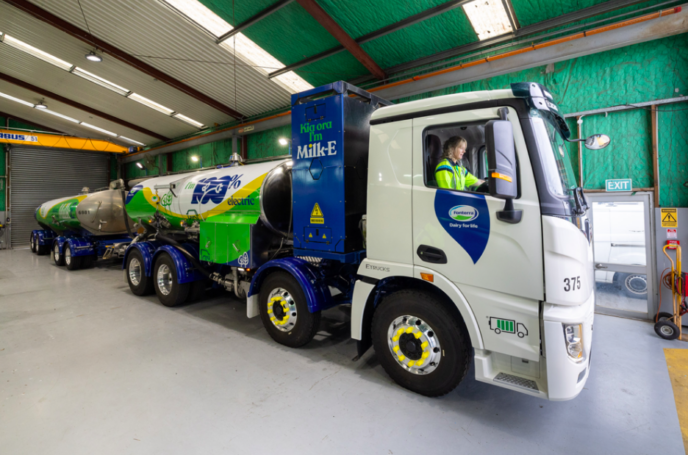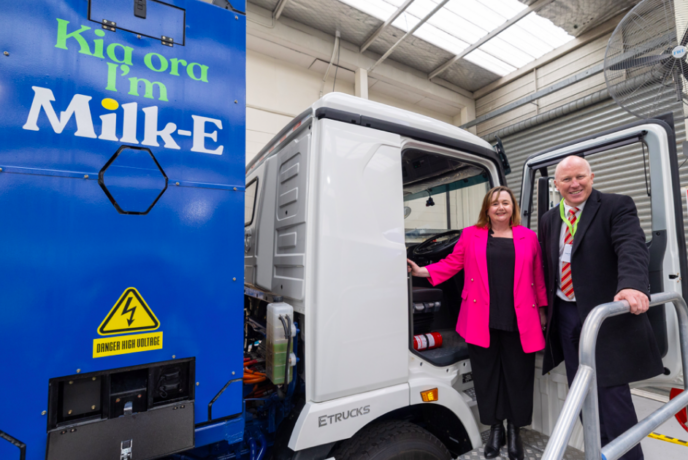
Fonterra has officially launched its first electric milk tanker called “Milk-E”.
It operates on battery-swap technology, meaning just a few minutes’ downtime to swap batteries which can be charged at off-peak times, said energy and resources minister Megan Woods in launching the e-truck on July 18 in Morrinsville shortly before attending NZ Post’s first hydrogen truck event.
Both projects were helped by Government funding, Woods adding that New Zealand’s (and possibly the world’s) first electric milk tanker is entering Fonterra’s fleet and Hyundai and NZ Post are getting the country’s first hydrogen truck on the road.
Woods highlighted the importance of organisations that operate large fleets, leveraging new technology to reduce their emissions.
“These Government partnerships with industry are vital to achieving our climate goals,” she said.
“It’s my hope these projects will deliver valuable lessons and financial insights that will be shared with others and can be replicated across the national heavy fleet.
“Transport makes up more than 20% of the country’s emissions, and heavy vehicles, most of which are for freight, emit almost a quarter of our total transport emissions,” Woods added.
“Heavy transport is harder to decarbonise than light transport, and it’s likely a mix of hydrogen, electricity and other low-emission fuels will be needed to help meet the Emissions Reduction Plan’s target to cut emissions from freight transport by 35% by 2035.
“These truck projects have the potential to be transformational for heavy transport. According to Hyundai, the truck will save emissions the equivalent of taking 100 cars off the road.
“In the dairy sector, nationwide annual emissions from Fonterra’s milk collection are estimated to be around 126,000 tonnes of CO2e, so if this project proves replicable it represents an excellent opportunity to make a huge cut to Fonterra’s heavy fleet emissions.”
Both projects received co-funding from the government’s Low Emissions Transport Fund (LETF), administered by the Energy Efficiency and Conservation Authority (EECA).
Fonterra received $427,000 in co-funding, of an estimated total cost of $850,000 to purchase the electric truck cab/chassis and convert it into a tanker. The work was completed by a local engineer who specialises in mounting Fonterra’s tanker barrels and Fonterra’s in-house service technicians who specialise in building their tankers.
Milk E, named by Fonterra farmer Stephen Todd from Murchison, will be based at Fonterra’s Waitoa plant and is one of a number of programmes that’s helping the co-op towards becoming a leader in sustainability.
“Right across the co-op our teams are constantly looking at how we can decrease our emissions – from on farm, to at our sites and throughout our transport network,” chief operating officer Fraser Whineray says.
“The team here at our Morrinsville Workshop have done a fantastic job of pulling this tanker together. Being a New Zealand first, there’s been a lot of creative thinking and Kiwi ingenuity to bring Milk-E to life.”
Changes to the battery configuration have given the team an opportunity to trial other additions to improve milk collection efficiencies, reduce safety concerns, and reduce the amount of work required to customise a Fonterra tanker.
“It’s been great to see the team turn challenges into opportunities so in addition to trialling Milk-E’s on-road ability, we’re also trialling a new electric pump, hose configuration and cabinetry,” Whineray says.
EECA investment and engagement group manager Nicki Sutherland says it’s great to see the project come to life.
“New Zealand has ambitious targets to rapidly reduce carbon emissions, and transport is key, but heavy freight has proven hard to decarbonise. If successful, this project could be replicated across a number of New Zealand businesses,” Sutherland says
Additional information
For more information check out the 10 facts about Milk-E here
Other work on Milk-E includes:
- An electric pump on the driver’s side has reduced the pipework on the truck by 3.4 metres, reducing tare weight.
- The milk hose now falls naturally back across the guards of the truck and is secured onto a Bayonet connection which locks the hose in place and seals the end of the hose in transit.
- Newly designed doors that open out sideways with minimal moving parts, resulting in improved safety.
- The need for a hydraulic tank and pump has been removed and a fully electric motor and pump has been installed.