

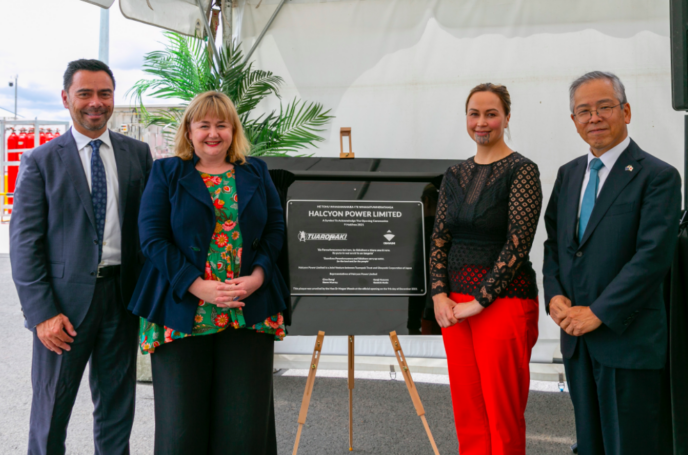
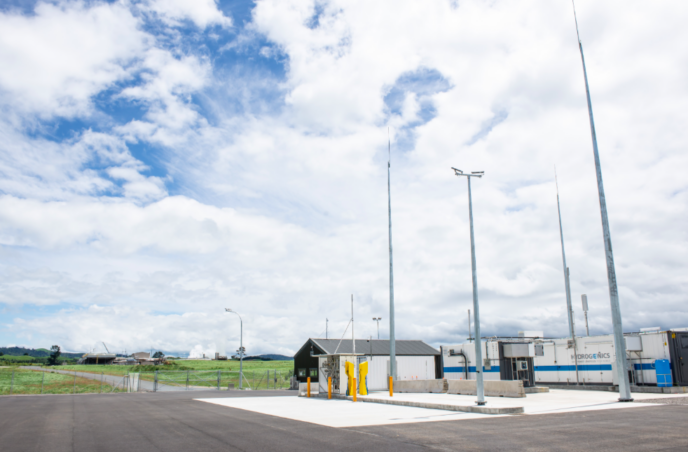
New Zealand’s first ‘green hydrogen’ plant near Taupo has been officially opened marking an important step towards decarbonisation of the country’s heavy freight industry.
Energy and resources minister Megan Woods attended the December 9 opening of the Halcyon Power Ltd plant.
The facility is a 50/50 joint venture between Tūaropaki Trust and Obayashi Corporation of Japan which has been in development since 2018.
Halcyon Power uses electricity generated by geothermal power to electrolyse water to produce green hydrogen.
It expects to begin wholesaling hydrogen domestically in January and will produce around 180 tonnes in the first year.
Tūaropaki chief executive Steve Murray says the ultimate aim is to complete a hydrogen supply chain that includes transportation, site storage and refuelling infrastructure.
Tūaropaki Trust has a track record of NZ firsts such as opening the Mōkai power station near Taupō in 2000 – the country’s first privately developed and owned geothermal plant.
Tūaropaki entered the joint venture with Obayashi to encourage the commercial production and wider use of hydrogen as a transport fuel.
Obayashi Corporation is one of Japan’s most successful construction companies, known for expertise and technological innovation, and played a key role in the construction of Auckland’s Waterview Connection road tunnel.
Technology for the plant, including the electrolyser, was supplied by Hydrogenics/Cummins.
The future of green hydrogen produced with renewable electricity is looked to not only replace fossil fuels in the transport sector but also to replace hydrogen used in industrial processes and produced using natural gas or coal.
“Halcyon Power aligns with our values to look after our environment and champion research and development of alternative renewable energy,” Murray says.
“While helping New Zealand decarbonise, this project opens up the potential for the country to export hydrogen and intellectual property related to hydrogen as a transport fuel.”
Tūaropaki chair Gina Rangi says the hydrogen plant was a step towards the country’s goals of zero net greenhouse gas emissions by 2050.
In a videoed address Obayashi Corporation president Kenji Hasuwa says hydrogen production and application was a major trend in decarbonisation with the state-of-the-art facility enhancing the country’s competitiveness in the area. The completion of the plant was not the endpoint, he says.
“Together with Tūaropaki we will investigate building a hydrogen supply chain in New Zealand that spans production, transportation and application, and contribute to the greening of the country.”
Halcyon Power project manager Aya Inagaki says commissioning of the plant was now complete, and post commission due diligence should be completed by the end of December.
At this stage, retailers will be able to collect the gas which would be priced competitively to enhance its attractiveness as an alternative fuel, Inagaki says.
Normally electric fuel cell vehicles would require around 5kg to fill the tank, for a range of around 600-800km.
Multi-million dollar export opportunity for NZ
The Government released a hydrogen green paper in 2019 which looked towards a national vision for hydrogen in areas such as transport.
The paper outlines the role hydrogen can play in New Zealand’s economy, and what can be done to accelerate its use.
“I consider green hydrogen as one of the potential tools that will help assist us to reduce global emissions,” Woods said at the time of the release.
“With hydrogen, we have opportunities to create new jobs, convert heavy transport away from fossil fuels, enhance our security of electricity supply and even generate significant export revenue.
“For a country blessed with abundant renewable energy, the ability to convert our clean electricity into green hydrogen which can fetch a premium on global markets is a major economic opportunity,” she said.
Meanwhile, according to a recent report by consultancy McKinsey & Company and commissioned by Meridian and Contact Energy, green hydrogen has the potential to earn hundreds of millions in export revenue for New Zealand and help decarbonise economies both here and overseas.
There is a strong focus on using green hydrogen to decarbonise sectors such as heavy transport, aviation, shipping and agriculture.
More than NZ$200b has already been committed by governments and the private sector around the world to support the development of hydrogen economies.
The report estimates global demand could increase more than sevenfold to 553 million tonnes by 2050 and Southland NZ is also tipped as a growth region for the resource.


