


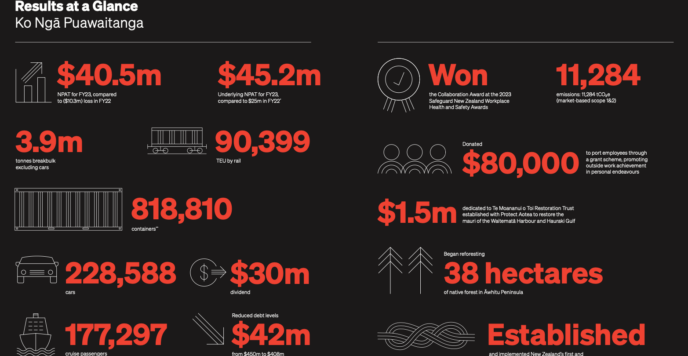
Port of Auckland has recovered from last year’s financial loss on the back of its failed automation project and posted a full-year net profit after tax of $40.5 million.
That’s an increase of more than $50m on last year’s $10.3m loss with revenue increased to $320.2m compared to $265.3m in FY22.
The result sees nearly a doubling in dividends to shareholder Auckland Council with directors declaring a final dividend for the year of $15m or 10.3 cents per share. It brings declared dividends to $30m for the year – an increase of $15.8m on the prior year and $13m more than originally committed.
The port also reduced net debt levels from $449.9m in FY22 to $407.5m in FY23.
The result included the handling of 228,588 vehicles, 818,810 containers and 3.9 million tonnes of breakbulk. It also saw over 170,000 cruise passengers arriving into Auckland as the industry returned post Covid-19.
Chief executive Roger Gray says the result follows its first year under a new strategic direction.
“Regaining our Mana is designed to safely lift performance, deliver returns to our owner Auckland Council, and to rebuild the trust of our people and Aucklanders.
“There have been substantial efforts and successes in our three focus areas which are reflected in our strong financial results, the transformation of our employee relations, and the safety and wellbeing of our people,” Gray says.
During the financial year, the port only closed for three days across both the Auckland Floods and Cyclone Gabrielle events. This was due to high winds and as soon as the winds dropped the port was back servicing freight needs.
“We are pleased with the resilience of Auckland’s port and see it as an asset serving the whole North Island,” Gray says.
“Our revised strategy sees us thinking more widely in regard to environmental, social, and governance matters.
“For us, sustainability is broader than just emissions and environmental impact. It’s about the communities we exist in. It’s about providing meaningful, high-paying jobs and it’s about building sustainable relationships within the diverse communities we serve and within our workforce,” Gray says.
*Click here to read the full report.


