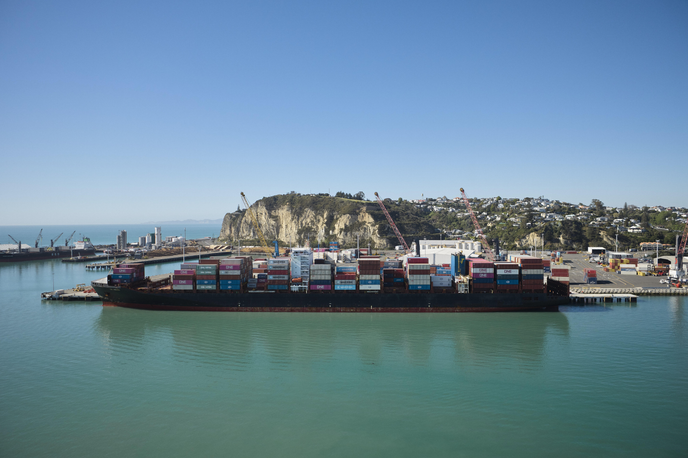
Napier Port has reported a 15% increase in net profit after tax to $35.5 million for the year ended September 30, supported by higher container revenue and an improved cargo mix.
Revenue increased 11.7% to $176.2m, while the result from operating activities rose 17.9% to $75.7m.
Underlying net profit after tax, excluding asset write-downs, insurance receipts and related tax impacts, increased 30.5% to $36.9m.
The port’s operating margin improved from 40.7% to 43%.
Napier Port chair Blair O’Keeffe says the result was achieved despite uncertainty affecting global trade.
“2026 was a strong year of service delivery and continued earnings growth for Napier Port,” O’Keeffe says.
“The result reflects the strength of our diverse cargo base, continued progress with our yield and cost management strategies, and the resilience of Hawke’s Bay’s primary sector, which together turned higher revenue into earnings growth.”
Container volumes were unchanged at 250,000 TEU, but full container volumes increased 5% following higher exports of apples, meat and timber and increased imports of paper products and fertiliser.
Empty and other container volumes fell 5.6%, driven by lower transhipment activity.
Average container services revenue per TEU increased 18.9%, reflecting a higher-yielding cargo mix, tariff and levy increases and growth in vessel-call revenue and Viewpoint supply-chain services.
Chief executive Todd Dawson says Viewpoint recorded increased demand from customers outside Hawke’s Bay.
“Viewpoint, our supply chain services business, had a record year with continued volume growth as more customers from outside our region chose to move their cargo through Napier Port, most of it by rail between Napier and Palmerston North,” Dawson says.
Bulk cargo volumes declined 2.7% to 3.32 million tonnes.
Log exports fell 2.8% to 2.6 million tonnes as subdued market conditions and higher costs continued to affect exporters.
Bulk imports decreased 7.2% due to lower oil product and cement volumes, while other bulk exports increased, primarily because of higher coastal fertiliser movements.
Average bulk cargo revenue per tonne increased 7.2% following tariff and levy increases and a higher-yielding cargo and vessel mix.
Cruise vessel visits fell from 78 to 55, generating $6.5m in revenue, down 20.8% from the previous year.
Investment programme advances
Napier Port recorded capital asset additions of $45.7m during the year as it progressed a three-year investment programme.
Spending included the container terminal transformation project, new mooring equipment, dredge construction payments, mobile plant replacements and major maintenance work on mobile harbour cranes and marine vessels.
“We are now past the midpoint of our three-year strategic investment programme,” Dawson says.
“Our ShoreTension mooring system went live at 6 Wharf, our new dredge Kapuka, co-owned with Port Otago, was launched, and our container terminal transformation project ‘NPT’ moved into operational testing.”
Napier Port’s private 5G network is now operational, while its first battery-electric truck is undergoing testing.
“With our private 5G network live and our first battery-electric truck undergoing testing on port, we are progressing toward autonomous truck and trailer operations in our container terminal during 2027,” Dawson says.
Customer satisfaction increased to eight out of 10, matching the port’s highest score since its annual survey began.
Eligible employees will receive $4182 each through an employee recognition scheme, paid through a combination of cash and Napier Port shares.
The port ended the financial year with gross drawn debt of $132.6m and $47.4m in undrawn banking facilities. Its net debt coverage ratio increased from 1.40 times to 1.62 times.
Directors declared a fully imputed final dividend of 9.25 cents per share, worth $18.5m, taking total dividends for the financial year to 14.5 cents per share.
The final dividend will be paid on December 15 to shareholders registered by December 3.
Growth forecast for 2027
Napier Port expects its underlying result from operating activities to reach between $80m and $85m in the 2027 financial year, assuming current market conditions continue.
The company is also completing due diligence on future container crane replacements and expects to make a final investment decision during the current financial year.
Any crane investment would be additional to its existing capital expenditure guidance for the 2025-to-2027 period.
“Demand for the region’s food and fibre exports remains strong, and shipping lines are showing further interest in growing their services through Napier Port,” Dawson says.
“We are mindful of global uncertainty, higher fuel and transport costs for exporters and importers, and a market that is sensitive to inflation.
“With port capacity across New Zealand expected to tighten in the near term, Napier Port is well positioned to grow and offer customers a genuine choice.”
The port currently has 48 cruise vessel bookings for the 2027 season and reports increasing bookings for the 2028-29 season.