The Transport Accident Investigation Commission has called for improvements to heavy-haulage permits and emergency warning systems after a freight train struck a truck stranded on a Waikanae level crossing.
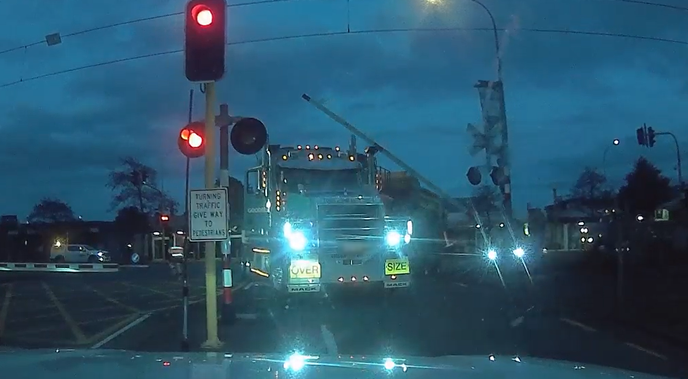
The collision occurred at the Elizabeth Street crossing on October 15, 2025, after a truck and trailer carrying an articulated dump truck turned off Main Road and stopped unexpectedly across the railway tracks.
TAIC found the trailer brakes were applied without being commanded by the driver and remained locked on after the vehicle’s air-brake hoses became disconnected.
The hoses were dislodged by an incorrectly stowed broom during the tight turn onto the crossing.
A northbound freight train approached while the truck remained immobilised. Its driver applied emergency braking but struck the vehicle at 68km/h.
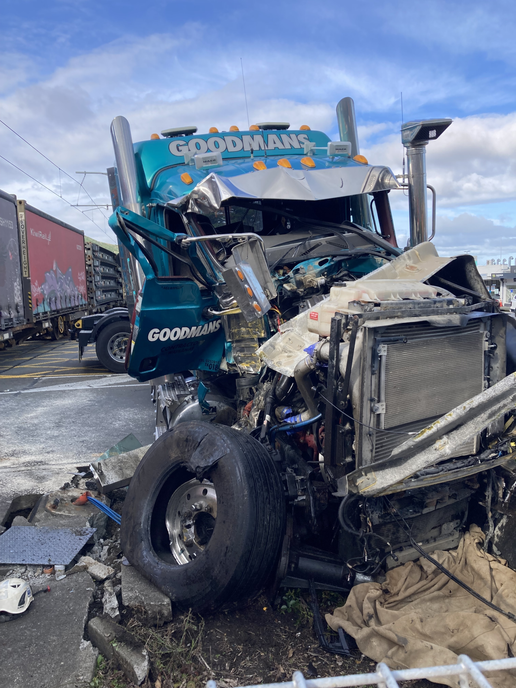
The truck driver escaped five seconds before impact. There were no injuries, but the truck was extensively damaged.
TAIC identified four wider safety issues involving permit conditions, KiwiRail’s permit-management processes, the absence of automated obstruction warnings and a lack of visible emergency contact details at the crossing.
Train control not notified
The trucking operator, Goodmans, believed it was not required to contact train control before using the crossing.
That understanding dated back to a 2014 permit involving clearance from overhead electric power lines.
TAIC says it was “as likely as not” that the permit confused traction control, which manages electricity supply, with train control, which manages train movements.
KiwiRail repeated the train-control exemption in permits issued every six months for about 10 years.
The exemption was removed in May 2024, but TAIC found the operator was not told that it was now required to contact train control.
The commission says this meant a critical safety control was not used before the heavy-haulage vehicle entered the crossing.
TAIC recommends that NZTA work with KiwiRail and the New Zealand Heavy Haulage Association to identify operators potentially relying on historical exemptions that have not been formally confirmed.
It also wants heavy-haulage companies to check their current permits rather than rely on earlier practices or understandings.
Permit system criticised
TAIC found KiwiRail had treated permit renewals and changes primarily as administrative matters.
The process lacked adequate operational risk assessments and systems for monitoring whether operators complied with permit conditions.
The commission recommends that KiwiRail involve appropriate operational staff when assessing permits or variations from standard procedures.
“A permit is a safety control; issuing or changing one should involve people who understand the operating risks,” TAIC says.
The investigation also found no automatic system was available to detect a vehicle obstructing the crossing and alert train control.
TAIC says an earlier warning could have allowed the freight train to slow further or potentially stop before reaching the crossing.
It recommends that KiwiRail identify and implement practicable early-warning systems for level-crossing emergencies.
“Detecting obstructions should not depend entirely on humans raising the alarm,” the commission says.
No train-control emergency number or crossing-location information was displayed at Elizabeth Street, while the emergency number was also absent from the operator’s permit.
Although TAIC found that displaying the number was unlikely to have prevented this particular collision, it says drivers and members of the public should be able to identify a crossing and report an emergency quickly.
It recommends KiwiRail display emergency contact and location information at level crossings where practicable and include the details on permits.
Safety changes introduced
Goodmans has modified the air-brake systems used on its trucks, including changes to couplers and connections intended to reduce the risk of unexpected disconnection.
KiwiRail has instructed staff not to use the historical arrangement understood by Goodmans.
It has also told TAIC it plans to improve permit assessments, investigate early-warning technology and review the provision of emergency contact information.
The New Zealand Heavy Haulage Association has undertaken to issue safety alerts reminding operators to contact train control when required and warning about the risk of brake-line disconnections.
TAIC has retained the road-rail interface on its 2026 Watchlist and is calling for regulators, transport operators and road controlling authorities to work together on level-crossing safety.
“The Elizabeth Street collision shows why this work matters,” the commission says.
“Effective permit arrangements and early warning systems could have reduced or even negated the risk of a collision.”